When a company adopts a new tool, results often get worse before they get better. This pattern has a name, it is predictable, and it remains one of the main reasons technology projects are abandoned too soon.
There is a moment in almost every digital transformation project that always looks the same.
Things start working worse than before. The data does not match. The team moves more slowly. And sooner or later, someone says out loud what everyone else is thinking: “We paid for this?”
What very few organizations realize is that this moment has a name, a shape, and is completely predictable. It is called the J-Curve Effect.
The pattern is always the same: when a new tool is introduced, performance drops first. Then it improves. And eventually, it rises above the starting point.
This happens with ERPs, CRMs, Business Intelligence platforms, automation tools, and AI systems. No exceptions.
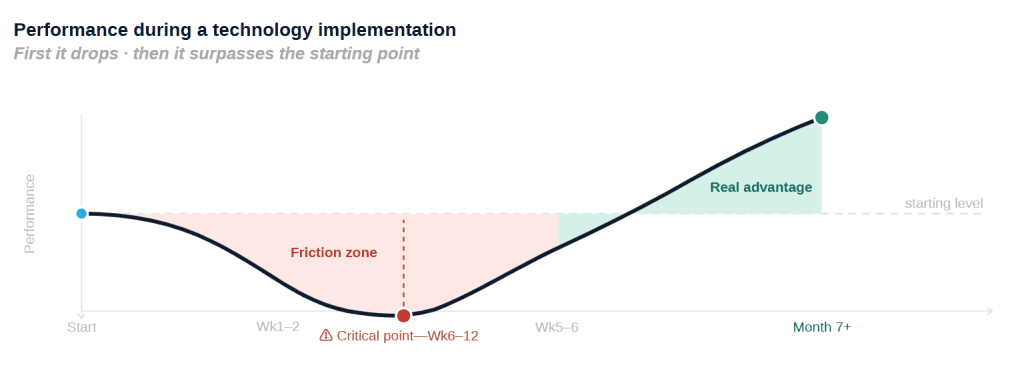
This is not a system failure. It is the result of three factors that almost always show up together:
The bottom of the curve is the most dangerous stage. Not because it is the most technically complex, but because the investment has already been made and the results are still not visible.
That is exactly where many organizations turn back.
And when they do, they end up with the worst of both worlds: they pay the cost of change without getting any of the benefits.
The question that determines the outcome is not whether the tool works. It is whether the organization can hold on long enough to make it out of the valley.
The curve is not fixed. Its depth depends on factors that can be managed:
Organizations that understand the J-Curve Effect before they begin have a simple but decisive advantage: they do not interpret the initial drop as failure. They recognize it as a phase. And they reach the point where technology starts creating value faster.
In the fitness industry, where data comes from multiple sources and integration is often complex, understanding this in advance can make the difference between a successful implementation and an investment that gets abandoned halfway through.


